GOOD NEWS › EXECUTIVE DIRECTOR BLOG › Message from Our Executive Director
Message from Our Executive Director
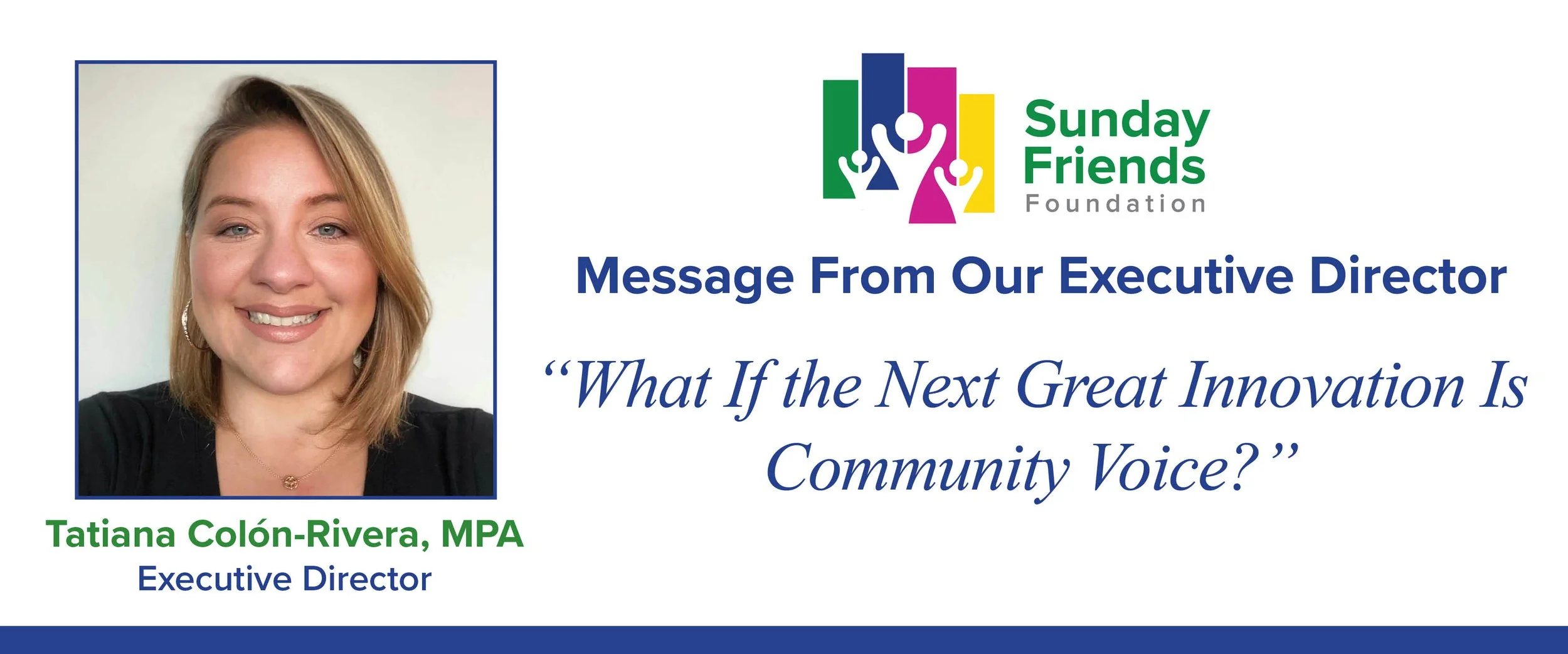
“What If the Next Great Innovation Is Community Voice?"
Silicon Valley has built its reputation by reimagining what's possible. Yet one of our greatest opportunities for innovation has nothing to do with artificial intelligence, biotechnology, or venture capital. It lies in rethinking how nonprofits design programs—with the people they serve not as participants, but as partners.
Every day, nonprofit organizations across Santa Clara County work tirelessly to address poverty, food insecurity, housing instability, educational inequities, and health disparities. Their commitment is extraordinary. Yet despite decades of investment, too many families continue to struggle.
Silicon Valley by the Numbers
Santa Clara County has a median household income of $164,281, yet 7.1% of residents—more than 130,000 people—live below the federal poverty line.¹
Santa Clara County has nearly 1.9 million residents and more than 49,000 employer establishments, underscoring the extraordinary economic resources of the region alongside the persistent challenges facing many families.²
Food insecurity remains a local concern: Feeding America’s latest Map the Meal Gap estimates food insecurity at the county level annually, including separate estimates for children and other populations—showing why local, community-informed approaches remain essential even in a region with significant wealth and resources.³
Don’t work harder. Listen better.
Nonprofits have become exceptionally good at measuring outcomes, writing reports, and meeting grant requirements. Those responsibilities matter. But too often, accountability flows upward to funders instead of outward to the communities whose lived experiences should help shape our work.
Community engagement can easily become a focus group, a survey, or an advisory committee convened after the important decisions have already been made. That isn't partnership. It's consultation.
The people living these challenges possess knowledge that no consultant, executive, or funder can fully replicate. They understand the barriers because they navigate them every day. When we fail to recognize that expertise, we risk designing solutions based on assumptions rather than lived reality.
At Sunday Friends, we've learned that lasting change begins by recognizing the strengths families already have. When people help shape the solutions, they are more likely to believe in them, improve them, and sustain them. Community voice isn't another program or initiative. It's a different way of leading.
After more than 20 years in the nonprofit sector and the past three years serving as Executive Director of Sunday Friends, I've found myself asking different questions. How do we move beyond helping families manage poverty and instead create pathways to lasting opportunity? How do we build organizations that share leadership, cultivate trust, and see community members not as beneficiaries, but as experts in their own lives?
I don't believe any one organization has all the answers. But I do believe Silicon Valley's nonprofit community has an opportunity—and perhaps an obligation—to rethink how we define leadership and impact.
If we are willing to listen more deeply, share decision-making, and embrace community voice as a core strategy, we may discover that Silicon Valley's next great innovation won't come from technology.
It will come from communities empowered to help lead the way.
Join us September 18 for Inside Poverty & the 2026 Silicon Valley Kindness Awards, and be part of the conversation about how we can build stronger communities together.
¹ U.S. Census Bureau, 2024 American Community Survey, 1-Year Estimates, Santa Clara County, California. The Census Bureau reports a median household income of $164,281 and a poverty rate of 7.1% for Santa Clara County.
² U.S. Census Bureau, QuickFacts: Santa Clara County, California. The county had an estimated 1,926,325 residents and 49,154 employer establishments in 2023.
³ Feeding America, Map the Meal Gap 2026, using 2024 data. The study provides annual county-level estimates of overall and child food insecurity and is designed specifically to show how food insecurity varies at the local level.